
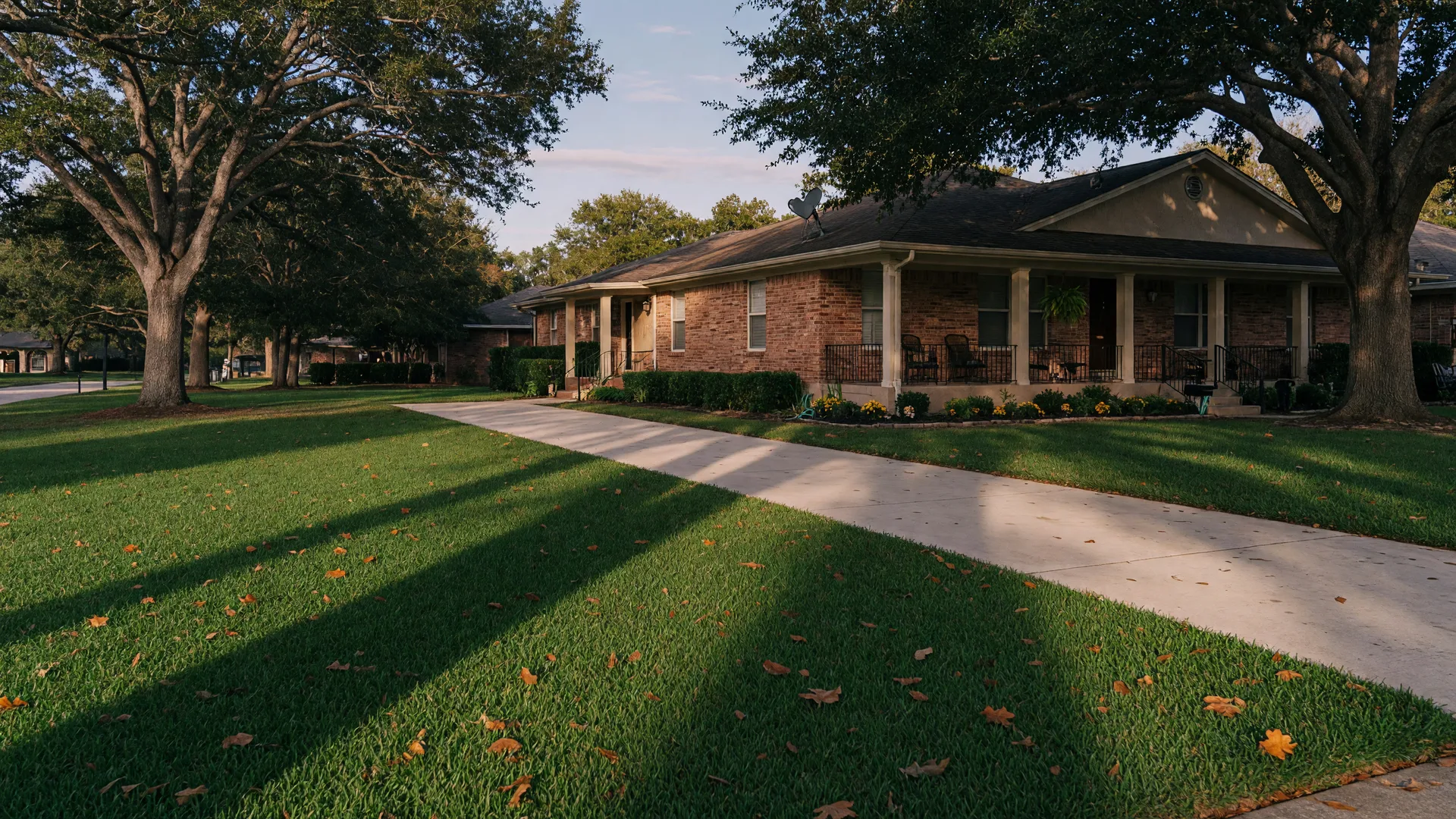
November is the month a Cinco Ranch lawn asks to be left alone. The grass that covers most Katy-area yards, St. Augustine, is a warm-season grass: it grew hard through the summer, and as nights cool it slows down, stores what it can, and heads into winter dormancy. The fall mistakes that cost homeowners in this area the most are opposite from the summer mistakes. In summer the problem is doing too little; in November it is doing too much, too late. Here is the honest November plan for a St. Augustine lawn, based on the lawn guidance Texas A&M AgriLife Extension publishes for Houston-area lawns.
November is the month to stop, not push
Two dates frame fall for a Katy lawn. First frost for the Houston area typically lands between late November and early December, with Houston's median first 32-degree freeze on December 24 under NOAA's 1991-2020 climate normals, the same calendar the freeze-prep guide walks through. Everything a warm-season lawn needs done before winter has a deadline a few weeks ahead of that date. If it is already November, most of those deadlines have just passed, and the right move is usually to stop rather than catch up.
Fertilizer: your last application is behind you
Texas A&M's St. Augustinegrass Home Lawn Maintenance Calendar says the final nitrogen application should come four to six weeks before the first historic frost, and never on stressed grass. For the Houston area, where first frost usually waits until late November or early December, that puts the last feeding roughly between mid-October and mid-November. If you fertilized in October, the season's feeding is finished; skip November nitrogen entirely. Nitrogen applied too late forces tender, succulent growth that winter temperatures take out and that delays spring green-up. Texas A&M's fertilizing guide notes that late-fall nitrogen, when used at all, should stay modest, a third of a pound or less per 1,000 square feet, because the goal in November is hardiness, not growth.
Mowing: keep it tall, never scalp
Texas A&M's calendar calls for keeping St. Augustine at roughly 2.5 to 3 inches, and 3 to 3.5 inches in shady lawns, and it says plainly not to scalp the lawn going into winter. The leaf area a lawn carries into dormancy is its carbohydrate reserve, and it is what powers spring green-up. As growth slows you mow less often, but keep mowing as needed so winter annual weeds never grow tall enough to flower and set seed.
Aeration: the fall job still worth doing
Fall core aeration sits on Texas A&M's fall calendar for St. Augustine lawns, and it makes sense on Katy's heavy clay soil. Aerating now, while soil temperatures still let the grass recover before full dormancy, relieves compaction from a summer of sprinklers, foot traffic, and play. If you have not done it and the ground is still workable, early November is a reasonable window; once the lawn goes fully dormant, wait for spring.
Skip the ryegrass overseeding
Every fall, stores around Katy sell bags of winter grass and St. Augustine seed. There is no such thing as St. Augustine seed; the grass is established only from sod or plugs. What those bags actually contain is annual ryegrass, and Texas A&M does not recommend overseeding St. Augustine home lawns with it. The extra irrigation, fertilizer, and shade ryegrass demands stress the St. Augustine underneath and delay its spring green-up. A green winter lawn is a Bermuda grass practice; on a St. Augustine lawn, the best November look is a healthy, tall, slightly golden lawn that bounces back in spring.
Winter weeds: the pre-emergent window a November lawn has mostly missed
The winter annuals that Katy lawns fight, henbit, annual bluegrass (Poa annua), chickweed, dandelion, and clover, germinate in fall and grow through winter. The right tool is a fall pre-emergent, and Texas A&M keys the timing to soil temperature: apply when the soil at 2 to 4 inches holds near 70 degrees for four to five consecutive days, which for the Houston area typically lands in the window from roughly mid-September through October. If you put down a fall pre-emergent in September or October, the work is done. If you did not, the honest answer is that an early-November application is mostly past the effective window, and many products simply waste your money applied this late. Instead, wait for the weeds to appear, identify them, and treat them this winter or early spring with a post-emergent product labeled for that weed and for St. Augustine. Read the label, follow the rate, and spot-treat rather than blanketing the yard.
Watering: taper it as the grass slows
A warm-season lawn uses less water as it slows, and over-irrigating St. Augustine in fall encourages shallow roots, disease, and winter weeds. Ease the sprinkler schedule as nights cool, and keep an eye on freeze forecasts: shutting down an irrigation system concerns the backflow assembly as much as the grass, which the freeze-prep guide covers in detail. Watering-day rules in this area are set by your local water provider and can change with conditions, so check with yours before assuming the summer schedule still applies.
Related guides on this site
- Freeze prep in Cinco Ranch: pipes, sprinklers, and pools
When the first freeze usually lands, and how to shut the irrigation system down at the backflow preventer.
- Setting up utilities when you move to Cinco Ranch
Where a Cinco Ranch lawn's water actually comes from, and who sets the rules.
- How the Cinco Ranch HOA works
If your section's association enforces yard standards, this is where to start.
Primary sources used in this post
- St. Augustinegrass Home Lawn Maintenance Calendar (HORT-PU-170), Texas A&M AgriLife Extension
The fertilizer-timing, mowing-height, and fall aeration guidance.
- Fertilizing Texas Lawns (E-436), Texas A&M AgriLife Extension
Why late-season nitrogen, when used at all, stays modest.
- Maintaining St. Augustinegrass Lawns, Harris County AgriLife Extension
The Houston-area reference for keeping St. Augustine healthy through the year.
- Turfgrass Establishment for Texas, Texas A&M AgriLife Extension
Why St. Augustine is established only vegetatively, never from seed.
- Realty Pros of Texas
The brokerage behind this guide, with Carol Jukes as Broker/Owner.
Realty Pros of Texas
Thinking about buying in Cinco Ranch?
Lawn questions usually mean home questions, and home questions deserve a local answer. Whether you are comparing sections or getting a yard ready to sell, a conversation with Carol Jukes, Broker/Owner of Realty Pros of Texas, is free and comes with no obligation.
Talk to CarolWritten for living in Cinco Ranch
Carol Jukes is the Broker/Owner of Realty Pros of Texas, serving Katy, Houston, and surrounding communities with 35+ years in real estate and 1,500+ homes sold, Licensed Texas broker since 2006. Questions about this post or the community? She is one phone call away: (832) 212-2772.
All articles