
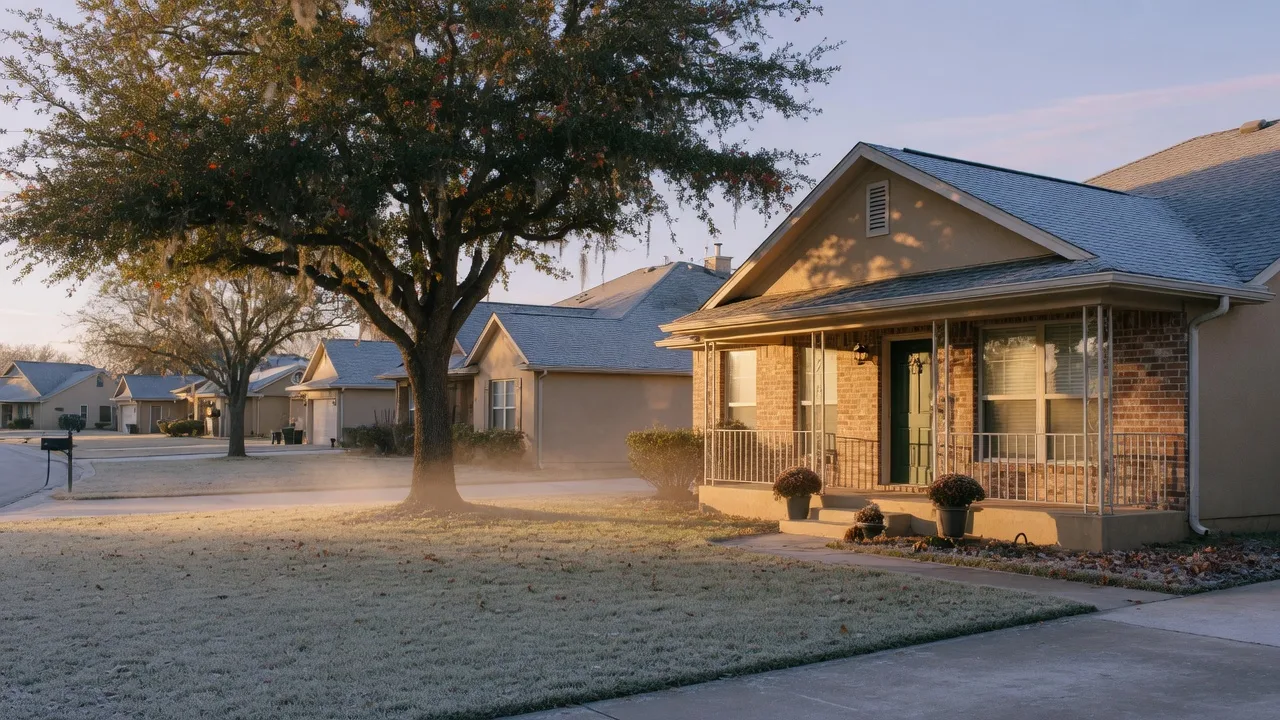
When does a Cinco Ranch home need freeze prep? The honest answer is before the cold arrives, not during it. Katy's first freeze usually waits until December, but Texas weather does not follow the calendar, and the two freezes every Houston-area homeowner remembers, February 2021 and late January 2025, both arrived in the middle of winter. The February 2021 storm, Winter Storm Uri, was the coldest winter storm for Texas since December 1989, with winter storm warnings covering every county in the state, and the damage it left behind was dominated by burst pipes. This guide is the freeze checklist for a Cinco Ranch home: the pipes, the sprinklers, the pool, the heat, and the alerts that match your address.
When the first freeze usually comes
NOAA's 1991-2020 U.S. Climate Normals put the median first 32-degree freeze for the Houston area on December 24, and local frost-date references built on the same normals put Katy's first frost risk in early December. A hard freeze in November is possible but not the norm, and a hard freeze in late January or February is entirely normal. The useful way to read the calendar: start the checklist in November, when the first strong cold fronts arrive, and treat the first freeze forecast of the season as a deadline rather than a maybe. Houston's official climate station recorded its coldest reading of 2025, 20 degrees, on January 22 of that year, so the season runs well past the holidays.
What actually breaks in a Texas freeze
Water expands when it freezes, and a Cinco Ranch home carries more water-bearing systems than a typical city lot: copper and PEX supply lines, exterior hose bibs, an irrigation system with a backflow preventer, and often a pool with pumps and supply lines. The classic freeze damage is a pipe that freezes and bursts, which then floods the home when it thaws, usually through a ceiling, an exterior wall, or a garage. Two patterns matter here: many homes in the community have automated sprinklers, and many have pools, and both need specific attention that a general drip-your-faucets checklist does not cover.
The pipes checklist
- Disconnect, drain, and store garden hoses, and put insulated covers on outdoor hose bibs and faucets. A hose left connected can freeze water back into the pipe inside the wall.
- Wrap exposed pipes in attics, crawl spaces, garages, and along exterior walls with foam pipe sleeves or UL-listed heat tape, following the manufacturer's instructions.
- Open kitchen and bathroom cabinet doors on freezing nights so warm indoor air reaches the pipes under the sinks.
- On the coldest nights, let both hot and cold water drip slowly from the faucet farthest from the main shut-off; moving water is much less likely to freeze.
- Keep the house at a consistent temperature of at least 55 to 60 degrees, even if you are traveling, and know where your main water shut-off valve is before you ever need it.
Sprinklers: shut it off, drain it, wrap it
A lawn irrigation system is the most commonly damaged system in a suburban Texas freeze, and the damage is usually to the backflow preventer and the above-ground valves. The guidance from county MUDs is consistent on both the Harris and Fort Bend sides of the community:
- Shut off the water to the irrigation system at its shut-off valves, typically the two valves on either side of the backflow preventer, often the ones with blue handles.
- Turn off the controller or timer so the system does not cycle during the freeze.
- Drain the system completely, opening the bleeder valves to release pressure, and leave them open so any remaining water has room to expand.
- Wrap the backflow preventer and exposed supply lines in insulation.
- A licensed irrigation professional can do a full blowout with an air compressor, the thorough version of this job; several county MUDs recommend completing the whole process at least a week before a hard freeze is forecast.
Pools: keep the water moving, or winterize properly
For pools, the two safe paths are to keep the water moving or to winterize per the manufacturer and installer. The weather-safety guidance that Baylor College of Medicine publishes and county MUDs pass along says to keep the pool pump running so moving water does not freeze in the lines, and to drain pool supply lines following the manufacturer's instructions. Two rules apply everywhere: never put antifreeze in pool or sprinkler lines, and if you close the pool for winter, follow the installer's winterization steps, which typically cover the pump, filter, skimmer, and chemical balance. For most Cinco Ranch families who swim through the mild months, keeping the pump running on a freeze night is the simpler path.
Heat and power: the CenterPoint rules
CenterPoint Energy is the electric utility for most of the Houston area, including Katy, and its cold-weather guidance is the one to follow for the inside of the home:
- Have your heating system inspected and tuned annually, and change or clean the furnace filter before the season.
- Keep outdoor furnace and dryer vents clear of debris so the system exhausts properly.
- Use space heaters only with automatic shut-off, at least three feet from anything flammable, and never leave them on while you sleep or leave the house.
- Never run a portable generator indoors or in a garage; the carbon monoxide danger is real and the guidance is absolute.
- Stay at least 35 feet away from downed power lines and report them to CenterPoint at 713-207-2222.
Plants, pets, and the county's four-word rule
Fort Bend County's Office of Homeland Security and Emergency Management sums up freeze season in four words: protect people, pets, pipes, and plants. For people, check on elderly neighbors. For pets, bring them inside, even the cold-weather breeds. For plants, cover frost-sensitive ones or move potted plants under the porch or into the garage. For pipes, the checklist above. Harris County's Ready Harris program uses the same framing during hard-freeze warnings, so whichever county your address is in, the message is the same.
Which alerts to sign up for, by address
Cinco Ranch sits largely in unincorporated Harris and Fort Bend counties rather than inside the City of Katy, so the county alert systems are the ones that matter for most addresses, and which MUD supplies your water varies by section and street. The honest rule, the same one this site uses for taxes and schools, is to verify your own address.
- Harris County: Ready Harris posts freeze alerts and winter-weather messaging at readyharris.org.
- Fort Bend County: the HSEM Ready Fort Bend page covers preparedness, and FBC Alert is the county's opt-in notification service.
- City of Katy: KTALERT signup covers the addresses inside the city, at cityofkaty.com.
- Your MUD: freeze notices for your specific water system show up on your MUD's website, so bookmark it alongside the weather apps.
None of this replaces a good forecast. The National Weather Service office in Houston/Galveston is the source for freeze watches and warnings, and a hard freeze warning from NWS is the trigger to run the full checklist.
The timeline that works
If you do one thing this month, walk the yard with the checklist: disconnect hoses, note where your irrigation shut-offs are, and confirm your main water valve turns freely. The week a hard freeze is forecast, shut down the sprinklers, wrap the backflow preventer, and open the cabinets. The night before, drip the farthest faucet and keep the heat steady. Done in that order, it is what separates a Cinco Ranch home that sails through a freeze from one that spends January with a restoration crew. If a freeze lands on a school morning, Katy ISD announces weather-related delays and closures on its website and app the way it does for any severe weather.
The sources behind this guide, all accessed October 30, 2026:
- National Weather Service Houston/Galveston: the Valentine's Week storm of February 2021
NWS's documentation of Winter Storm Uri, the coldest winter storm for Texas since December 1989.
- Old Farmer's Almanac: frost dates for Katy, TX
Frost-date reference for Katy built on NOAA 1991-2020 normals; Houston's median first freeze is December 24.
- Houston Public Media: how to prepare your home for freezing weather
Local reporting with the pipe, drip, and heating guidance quoted from officials.
- Harris County WCID 119: preparing pipes for the winter
MUD guidance on hoses, faucet covers, wrapping, and dripping, relevant on the Harris County side.
- Fort Bend County MUD 128: tips for winterizing your home
Winterization guidance including irrigation shut-offs and pool steps on the Fort Bend County side.
- American Red Cross: preventing and thawing frozen pipes
The Red Cross checklist for pipes, cabinets, and the slow drip.
- CenterPoint Energy: cold-weather readiness plan
CenterPoint's February 2025 cold-weather plan and safety messaging for its Texas service area.
- Fort Bend County HSEM: Ready Fort Bend
Fort Bend County's preparedness hub and the protect people, pets, pipes, and plants framing.
- Ready Harris
Harris County's emergency management site with freeze alerts and winter-weather messaging.
- City of Katy: emergency notifications (KTALERT)
The city's opt-in notification signup for addresses inside Katy.
- Realty Pros of Texas, Carol Jukes
Carol's Katy brokerage, where she helps buyers and sellers get settled in Cinco Ranch.
Related reading from this site:
- Katy property taxes and MUDs: why the bill varies by address
Which county and MUD your address falls in shapes your water service and your bill.
- Setting up utilities when you move to Cinco Ranch
Know your providers, your shut-offs, and your water district before a freeze week.
- Hurricane season in Cinco Ranch: prepare before a storm forms
The other weather-prep checklist; hurricane season runs through November 30, so the two overlap.
- Cinco Ranch pools and amenity centers: how they actually work
What having a pool in the community involves, year-round.
- Pools, parks & trails
The community's outdoor life and shared amenities.
Realty Pros of Texas
Buying in Cinco Ranch before your first freeze?
A home inspection, a walk-through about the irrigation and pool systems, and a local agent who knows which MUD you will be dealing with all matter more in the fall than in any other season. Carol Jukes, Broker/Owner of Realty Pros of Texas, has helped buyers and sellers in Cinco Ranch for years and is happy to answer the questions a listing page cannot.
Ask Carol about a Cinco Ranch homeFreeze prep is a two-week calendar item, not a season: walk the yard in November, shut down the sprinklers when a freeze is forecast, and keep the heat steady on the night of. Handled that way, a Texas freeze is a good excuse for a quiet weekend instead of a claim on your deductible. If you are weighing a move to Cinco Ranch or thinking about your current home, Carol Jukes at Realty Pros of Texas is one call away at (832) 212-2772.
Written for living in Cinco Ranch
Carol Jukes is the Broker/Owner of Realty Pros of Texas, serving Katy, Houston, and surrounding communities with 35+ years in real estate and 1,500+ homes sold, Licensed Texas broker since 2006. Questions about this post or the community? She is one phone call away: (832) 212-2772.
All articles